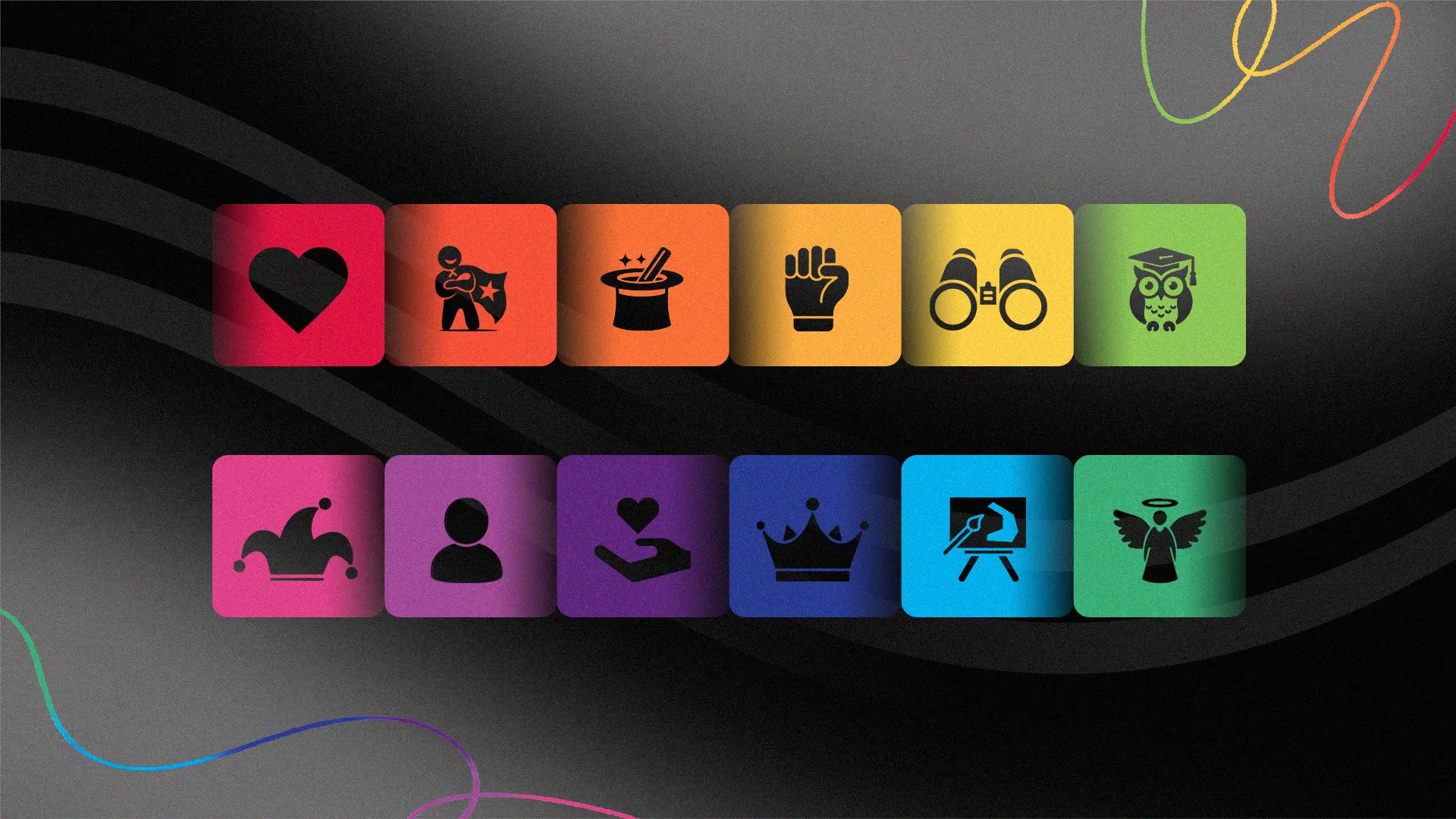
A brand archetype is a personality type for your brand, based on characters people recognise instinctively: the Hero, the Rebel, the Caregiver and so on. The idea comes from psychologist Carl Jung and was turned into a 12-archetype branding framework by Margaret Mark and Carol S. Pearson in their 2001 book The Hero and the Outlaw. Choosing one gives your brand a consistent voice, look and behaviour, so customers know what to expect from you before they have bought anything.
This guide explains all 12 archetypes, how to choose yours without overthinking it, and how to use it in your content and design.
Why brand archetypes are useful
Most brands do not fail because their logo is wrong. They fail because they feel like no one in particular. A clear archetype fixes that:
- It makes decisions faster. Should this caption be playful or serious? Should this photo be polished or raw? The archetype answers it.
- It keeps everyone consistent. Designers, copywriters, social media managers, agencies and staff all work from the same personality.
- It makes you memorable. People remember characters more easily than lists of features.
- It helps you stand out. If every competitor is a Ruler, being the Everyman or the Jester is an instant point of difference.
The 12 brand archetypes, with examples
The examples below are brands commonly used to illustrate each archetype. They are interpretations, not labels the brands chose for themselves.
| Archetype | What it wants | Personality | Often cited example |
|---|---|---|---|
| Innocent | Safety and happiness | Optimistic, simple, honest | Coca-Cola |
| Everyman | Belonging | Friendly, down to earth, inclusive | IKEA |
| Hero | To prove its worth through courage | Bold, determined, inspiring | Nike |
| Outlaw (Rebel) | Freedom from the rules | Disruptive, daring, unconventional | Harley-Davidson |
| Explorer | Freedom and discovery | Adventurous, independent | The North Face |
| Creator | To make something new | Imaginative, expressive, original | LEGO |
| Ruler | Control and order | Confident, premium, authoritative | Rolex |
| Magician | To make dreams real | Visionary, transformative | Disney |
| Lover | Intimacy and connection | Sensual, passionate, indulgent | Chanel |
| Caregiver | To protect and help | Warm, nurturing, reassuring | Volvo |
| Jester | To enjoy the moment | Playful, funny, irreverent | Old Spice |
| Sage | Truth and understanding | Wise, expert, trustworthy |
How to choose your brand archetype
You do not need a workshop with sticky notes for a week. Work through these five steps.
- Start with your customer, not yourself. What do your best customers want to feel when they choose you: safe, inspired, clever, pampered, part of something? Pick the archetype that delivers that feeling.
- Look at what you already do well. The archetype must be believable. A budget brand cannot be the Ruler, and a strict, technical firm will struggle as the Jester.
- Map your competitors. List the main competitors and the archetype each one seems to be. If they all cluster in one or two, there is an opportunity in the gaps.
- Choose one main archetype and, at most, one supporting one. A Sage with a touch of Jester is clear. A Sage, Jester, Hero and Lover is a brand with no personality.
- Test it. Write a short Instagram caption, a WhatsApp reply and a homepage headline in the archetype's voice. If it feels natural to your team and right to your customers, you have it.
Archetypes for UAE businesses
There is no fixed archetype for an industry, but some fit naturally. These are starting points, not rules.
- Cafés and restaurants: Everyman for a neighbourhood café, Creator for a specialty coffee or chef-led concept, Lover for indulgent dining and desserts.
- Real estate and holiday homes: Ruler for luxury developments and brokerages, Sage for investment-focused advisers, Caregiver for property management that looks after owners and guests.
- Beauty and aesthetics clinics: Caregiver for clinics that lead with safety and reassurance, Magician for transformation-led treatments, Lover for luxury spas and salons.
- Lifestyle and fashion: Explorer for travel and outdoor brands, Outlaw for streetwear, Lover or Ruler for luxury labels.
The opportunity is often in going against the grain. In a sector full of Rulers, a warm, plain-speaking Everyman can be the brand people actually remember.
How to use your archetype day to day
An archetype only works if it shows up everywhere customers meet you.
- Tone of voice. Write three to five rules, such as "short sentences, no jargon, a touch of humour", with examples of what to say and what not to say.
- Visual style. Colours, typography, photography and video should match the personality. A Sage looks calm and clear. A Jester can be bright and loud.
- Social media. The archetype decides your content mix: a Sage teaches, a Hero challenges, a Jester entertains, a Caregiver reassures.
- Customer service. WhatsApp replies, emails and how staff greet people are part of the brand too.
- Arabic and English. Make sure the personality carries into Arabic. Humour and formality do not translate word for word, so write each language natively.
Mistakes to avoid
- Choosing the archetype you wish you were. If customers do not recognise it in your service, it reads as fake.
- Mixing too many. Two is the maximum. More than that and the brand becomes confusing.
- Copying a competitor's archetype. You end up as a weaker version of someone else.
- Treating it as a logo exercise. The archetype is about behaviour and voice as much as visuals.
- Never revisiting it. If the business changes direction, check whether the archetype still fits, as part of any rebrand or refresh.
A quick checklist
- Decide how your best customers want to feel when they choose you.
- Pick one main archetype and, at most, one supporting one.
- Check it is believable for your business and different from competitors.
- Write tone of voice rules with examples.
- Match your visuals, social content and customer service to it.
- Write it natively in Arabic and English.